At&t Time of Year for Annual Employee Preformance Reviews
| @ | |
|---|---|
| At sign | |
| In Unicode | U+0040 @ COMMERCIAL AT (HTML@· @) |
| Related | |
| See also | U+FF20 @ FULLWIDTH COMMERCIAL AT (HTML@) U+FE6B ﹫ Minor COMMERCIAL AT (HTML﹫) |
The at sign, @ , is normally read aloud as "at"; it is also ordinarily called the at symbol, commercial at, or accost sign. Information technology is used as an accounting and invoice abbreviation meaning "at a rate of" (e.g. 7 widgets @ £2 per widget = £14),[1] but it is now seen more widely in email addresses and social media platform handles.
The absence of a unmarried English word for the symbol has prompted some writers to use the French arobase [2] or Spanish and Portuguese arroba, or to coin new words such as ampersat [3] and asperand,[4] or the (visual) onomatopoeia strudel,[5] merely none of these have accomplished wide use.
Although not included on the keyboard of the earliest commercially successful typewriters, it was on at to the lowest degree i 1889 model[6] and the very successful Underwood models from the "Underwood No. v" in 1900 onward. It started to be used in email addresses in the 1970s, and is at present routinely included on about types of computer keyboards.
History [edit]

@ symbol used as the initial "a" for the "amin" (amen) formula in the Bulgarian of the Manasses Chronicle (c. 1345).


@ used to signify French " à " ("at") from a 1674 protocol from a Swedish court ( Arboga rådhusrätt och magistrat )
The earliest notwithstanding discovered symbol in this shape is found in a Bulgarian translation of a Greek chronicle written past Constantinos Manasses in 1345. Held today in the Vatican Churchly Library, it features the @ symbol in place of the upper-case letter letter of the alphabet alpha "Α" every bit an initial in the word Amen; however, the reason backside it being used in this context is all the same unknown. The evolution of the symbol every bit used today is not recorded.
Any the origin of the @ symbol, the history of its usage is meliorate known: information technology has long been used in Catalan, Castilian and Portuguese as an abbreviation of arroba, a unit of weight equivalent to 25 pounds, and derived from the Arabic expression of "the quarter" ( الربع pronounced ar-rubʿ).[eight] An Italian academic, Giorgio Stabile, claims to have traced the @ symbol to the 16th century, in a mercantile document sent by Florentine Francesco Lapi from Seville to Rome on May four, 1536.[9] The document is almost commerce with Pizarro, in particular the price of an @ of vino in Peru. Currently, the word arroba means both the at-symbol and a unit of weight. In Venetian, the symbol was interpreted to hateful amphora ( anfora ), a unit of weight and volume based upon the capacity of the standard amphora jar since the 6th century.
Until now the kickoff historical certificate containing a symbol resembling an @ as a commercial ane is the Spanish "Taula de Ariza", a registry to announce a wheat shipment from Castile to Aragon in 1448; even though the oldest fully developed modernistic @ sign is the one found on the to a higher place-mentioned Florentine letter.[nine]
Mod utilize [edit]
Commercial usage [edit]
In gimmicky English usage, @ is a commercial symbol, pregnant at and at the rate of or at the cost of. It has rarely been used in financial ledgers, and is not used in standard typography.[10]
Trademark [edit]
In 2012, "@" was registered equally a trademark with the High german Patent and Trade Mark Office.[11] A cancellation asking was filed in 2013, and the counterfoil was ultimately confirmed by the German Federal Patent Court in 2017.[12]
Electronic mail addresses [edit]
A common contemporary utilise of @ is in e-mail addresses (using the SMTP arrangement), as in jdoe@example.com (the user jdoe located at the domain case.com). Ray Tomlinson of BBN Technologies is credited for having introduced this usage in 1971.[iv] [13] This idea of the symbol representing located at in the form user@host is also seen in other tools and protocols; for example, the Unix shell command ssh jdoe@example.cyberspace tries to constitute an ssh connection to the figurer with the hostname example.net using the username jdoe.
On web pages, organizations often obscure email addresses of their members or employees by omitting the @. This practice, known every bit address munging, makes the email addresses less vulnerable to spam programs that scan the net for them.
[edit]
On some social media platforms and forums, usernames are in the grade @johndoe; this type of username is frequently referred to equally a "handle".
On online forums without threaded discussions, @ is ordinarily used to announce a answer; for instance: @Jane to reply to a annotate Jane made before. Similarly, in some cases, @ is used for "attending" in email messages originally sent to someone else. For example, if an electronic mail was sent from Catherine to Steve, only in the torso of the email, Catherine wants to brand Keirsten enlightened of something, Catherine will start the line @Keirsten to indicate to Keirsten that the following sentence concerns her. This likewise helps with mobile electronic mail users who might not see bold or color in email.
In microblogging (such as on Twitter and GNU social-based microblogs), an @ before the user name is used to send publicly readable replies (eastward.g. @otheruser: Message text here). The blog and client software tin can automatically interpret these as links to the user in question. When included as function of a person'due south or company's contact details, an @ symbol followed by a name is unremarkably understood to refer to a Twitter handle. A similar utilize of the @ symbol was also made available to Facebook users on September 15, 2009.[14] In Net Relay Conversation (IRC), it is shown before users' nicknames to denote they have operator status on a channel.
Sports usage [edit]
In American English language the @ can be used to add information about a sporting issue. Where opposing sports teams take their names separated past a "five" (for versus), the away team can exist written first – and the normal "five" replaced with @ to convey at which squad's home field the game will be played.[fifteen] This usage is not followed in British English, since conventionally the home team is written first.
Computer languages [edit]
@ is used in various programming languages and other computer languages, although at that place is non a consistent theme to its usage. For example:
- In ALGOL 68, the @ symbol is cursory course of the at keyword; it is used to alter the lower leap of an array. For instance:
arrayx[@88]refers to an assortment starting at index 88. - In ActionScript, @ is used in XML parsing and traversal as a string prefix to identify attributes in dissimilarity to child elements.
- In the ASP.NET MVC Razor template markup syntax, the @ graphic symbol denotes the kickoff of lawmaking argument blocks or the first of text content.[16] [17]
- In Dyalog APL, @ is used every bit a functional fashion to modify or replace data at specific locations in an array.
- In CSS, @ is used in special statements outside of a CSS block.[18]
- In C#, it denotes "verbatim strings", where no characters are escaped and two double-quote characters represent a unmarried double-quote.[nineteen] As a prefix it also allows keywords to be used as identifiers,[20] a form of stropping.
- In D, it denotes function attributes: like:
@safe,@nogc, user defined@('from_user')which tin can be evaluated at compile time (with__traits) or@propertyto declare backdrop, which are functions that tin can exist syntactically treated as if they were fields or variables.[21] - In DIGITAL Command Language, the @ character was the control used to execute a command procedure. To run the control process VMSINSTAL.COM, i would blazon
@VMSINSTALat the command prompt. - In Forth, information technology is used to fetch values from the address on the top of the stack. The operator is pronounced as "fetch".
- In Haskell, information technology is used in so-called equally-patterns. This notation can exist used to give aliases to patterns, making them more than readable.
- in HTML, information technology can be encoded as
@[22] - In J, denotes function composition.
- In Java, it has been used to denote annotations, a kind of metadata, since version 5.0.[23]
- In LiveCode, it is prefixed to a parameter to indicate that the parameter is passed by reference.
- In an LXDE autostart file (equally used, for case, on the Raspberry Pi computer), @ is prefixed to a command to indicate that the command should be automatically re-executed if it crashes.[24]
- In ML, it denotes list concatenation.
- In modal logic, specifically when representing possible worlds, @ is sometimes used equally a logical symbol to denote the actual world (the world we are "at").
- In Objective-C, @ is prefixed to language-specific keywords such as @implementation and to form cord literals.
- In Pascal, @ is the "address of" operator (it tells the location at which a variable is found).
- In Perl, @ prefixes variables which contain arrays
@array, including array slices @array[2..5,seven,9] and hash slices@hash { 'foo' , 'bar' , 'baz' }or@hash { qw(foo bar baz) }. This use is known as a sigil. - In PHP, it is used just before an expression to make the interpreter suppress errors that would be generated from that expression.[25]
- In Python two.4 and up, it is used to decorate a function (wrap the function in another one at creation fourth dimension). In Python iii.5 and up, information technology is also used as an overloadable matrix multiplication operator.[26]
- In Razor, it is used for C# code blocks.[27]
- In Red, it functions as a sigil:
@prefixes instance variables, and@@prefixes class variables.[28] - In Scala, it is used to announce annotations (every bit in Java), and also to bind names to subpatterns in blueprint-matching expressions.[29]
- In Swift,
@prefixes "annotations" that tin exist applied to classes or members. Annotations tell the compiler to apply special semantics to the declaration like keywords, without adding keywords to the linguistic communication. - In T-SQL,
@prefixes variables and@@prefixes "niladic" system functions. - In several xBase-type programming languages, like DBASE, FoxPro/Visual FoxPro and Clipper, it is used to announce position on the screen. For example:
@one,1 SAY "Hi"to show the word "HELLO" in line 1, column ane.- In FoxPro/Visual FoxPro, it is as well used to indicate explicit pass by reference of variables when calling procedures or functions (but information technology is not an accost operator).[30]
- In a Windows Batch file, an
@at the start of a line suppresses the echoing of that command. In other words, is the aforementioned asEcho OFFapplied to the current line simply. Unremarkably a Windows control is executed and takes effect from the next line onward, merely@is a rare example of a command that takes effect immediately. It is nearly commonly used in the class@echo offwhich not only switches off echoing but prevents the command line itself from being echoed.[31] [32] - In Windows PowerShell, @ is used as array operator for assortment and hash table literals and for enclosing here-string literals.[33]
- In the Domain Name System (DNS), @ is used to stand for the
$ORIGIN, typically the "root" of the domain without a prefixed sub-domain. (Ex: wikipedia.org vs. www.wikipedia.org) - In assembly language, @ is sometimes used as a dereference operator.[34]
Gender neutrality in Spanish [edit]

Protester with banner showing "La revolución está en nosotr@s"
In Spanish, where many words cease in "-o" when in the masculine gender and stop "-a" in the feminine, @ is sometimes used as a gender-neutral substitute for the default "o" catastrophe.[35] For example, the word amigos traditionally represents non just male person friends, only besides a mixed group, or where the genders are not known. The proponents of gender-inclusive language would replace it with amig@due south in these latter two cases, and use amigos only when the group referred to is all-male and amigas only when the group is all female. The Real Academia Española disapproves of this usage.[36]
Other uses and meanings [edit]

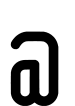
X-SAMPA uses an @ equally a substitute for ə, which it resembles in some fonts.
- In (especially English) scientific and technical literature, @ is used to describe the weather under which data are valid or a measurement has been made. Eastward.yard. the density of saltwater may read d = 1.050 g/cm3 @ 15 °C (read "at" for @), density of a gas d = 0.150 g/L @ xx °C, one bar, or racket of a car 81 dB @ 80 km/h (speed).[37]
- In philosophical logic, '@' is used to denote the actual world (in dissimilarity to non-actual possible worlds).[ citation needed ] Analogously, a 'designated' world in a Kripke model may be labelled '@'.[ citation needed ]
- In chemical formulae, @ is used to denote trapped atoms or molecules.[38] For instance, La@Cthreescore ways lanthanum within a fullerene cage. See article Endohedral fullerene for details.
- In Malagasy, @ is an informal abridgement for the prepositional class amin'ny.[ citation needed ]
- In Malay, @ is an breezy abridgement for the discussion "atau", pregnant "or" in English.[ citation needed ]
- In genetics, @ is the abridgement for locus, equally in IGL@ for immunoglobulin lambda locus.[39]
- In the Koalib language of Sudan, @ is used as a letter in Arabic loanwords. The Unicode Consortium rejected a proposal to encode it separately as a letter of the alphabet in Unicode. SIL International uses Individual Use Surface area code points U+F247 and U+F248 for lowercase and majuscule versions, although they take marked this PUA representation equally deprecated since September 2014.[40]
- A schwa, every bit the bodily schwa graphic symbol "ə" may be difficult to produce on many computers. Information technology is used in this capacity in some ASCII IPA schemes, including SAMPA and X-SAMPA.[ citation needed ]
- In leet it may substitute for the letter "A".[ citation needed ]
- Information technology is often used in typing and text messaging as an abridgement for "at".[41] [37]
- In Portugal it may be used in typing and text messaging with the meaning "french kiss" (linguado).[ citation needed ]
- In online discourse, @ is used by some anarchists as a substitute for the traditional circle-A.[ citation needed ]
- Algebraic notation for the Crazyhouse chess variant: An @ between a piece and a square denotes a piece dropped onto that square from the player's reserve.[42]
Names in other languages [edit]
In many languages other than English, although most typewriters included the symbol, the apply of @ was less common earlier e-mail became widespread in the mid-1990s. Consequently, it is often perceived in those languages as denoting "the Internet", computerization, or modernization in full general. Naming the symbol later on animals is also mutual.
- In Afrikaans, information technology is called aapstert , meaning 'monkey tail', similarly to the Dutch use of the discussion (aap is the word for 'monkey' or 'ape' in Dutch, stert comes from the Dutch staart).
- In Arabic, it is آتْ ( at ).
- In Armenian, it is շնիկ ( shnik ), which means 'puppy'.
- In Azerbaijani cluster, it is ət ( at ) which means 'meat', though near likely information technology is a phonetic transliteration of at.
- In Basque, it is a bildua ('wrapped A').
- In Belarusian, it is called сьлімак ( sʹlimak , meaning 'helix' or 'snail').
- In Bosnian, it is ludo a ('crazy A').
- In Bulgarian, it is called кльомба ( klyomba – 'a badly written letter'), маймунско а ( maymunsko a – 'monkey A'), маймунка ( maimunka – 'fiddling monkey'), or баница ( banitsa - a pastry gyre often made in a shape similar to the graphic symbol)
- In Catalan, it is called arrova (a unit of measure) or ensaïmada (a Mallorcan pastry, because of the similar shape of this food).
- In Chinese:
- In mainland Mainland china, it used to exist called 圈A (pronounced quān A ), pregnant 'circled A' / 'enclosed A', or 花A (pronounced huā A ), meaning 'lacy A', and sometimes equally 小老鼠 (pronounced xiǎo lǎoshǔ ), meaning 'trivial mouse'.[43] Present, for most of Prc's youth, it is called 艾特 (pronounced ài tè ), which is the phonetic transcription from at.
- In Taiwan, it is 小老鼠 (pronounced xiǎo lǎoshǔ ), pregnant 'piddling mouse'.
- In Hong Kong and Macau, it is at.
- In Croatian, it is nigh often referred to past the English word at (pronounced et), and less commonly and more formally, with the preposition pri (with the addressee in the nominative instance, not locative every bit per usual rection of pri ), meaning 'at', ' chez ' or 'past'. Informally, it is called a manki, coming from the local pronunciation of the English give-and-take monkey. Notation that the Croatian words for monkey, majmun, opica, jopec , šimija are not used to denote the symbol, except seldom the latter words regionally.
- In Czech information technology is called zavináč, which means 'rollmops'; the same word is used in Slovak.
- In Danish, information technology is snabel-a ('elephant's trunk A'). It is not used for prices, where in Danish à ways 'at (per piece)'.
- In Dutch, information technology is chosen apenstaart ('monkey'due south tail'). The a is the first grapheme of the Dutch word aap which means 'monkey' or 'ape'; apen is the plural of aap . However, the use of the English language at has become increasingly popular in Dutch.
- In Esperanto, it is called ĉe-signo ('at' – for the electronic mail use, with an accost like "zamenhof@esperanto.org" pronounced zamenhof ĉe esperanto punkto org ), po-signo ('each' – refers only to the mathematical use), or heliko (significant 'snail').
- In Estonian, it is called ätt , from the English give-and-take at.
- In Faroese, it is kurla, hjá ('at'), tranta , or snápil-a ('[elephant's] trunk A').
- In Finnish, information technology was originally chosen taksamerkki ("fee sign") or yksikköhinnan merkki ("unit price sign"), but these names are long obsolete and now rarely understood. Present, it is officially ät-merkki, according to the national standardization institute SFS; frequently likewise spelled at-merkki . Other names include kissanhäntä ('cat's tail') and miuku mauku ('miaow-meow').
- In French, it is now officially the arobase [44] [45] (also spelled arrobase or arrobe), or a commercial (though this is most commonly used in French-speaking Canada, and should normally simply be used when quoting prices; it should always exist called arobase or, better yet, arobas when in an e-mail address). Its origin is the same as that of the Spanish discussion, which could be derived from the Standard arabic ar-roub (اَلرُّبْع). In France, it is also common (specially for younger generations) to say the English word at when spelling out an electronic mail address.[ citation needed ] In everyday Québec French, one frequently hears a commercial when sounding out an electronic mail address, while Goggle box and radio hosts are more than probable to use arobase .
- In Georgian, it is at , spelled ეთ–ი (კომერციული ეთ–ი, ḳomerciuli et-i ).
- In German, it has sometimes been referred to as Klammeraffe (meaning 'spider monkey') or Affenschwanz (meaning 'monkeys tail'). Klammeraffe or Affenschwanz refer to the similarity of @ to the tail of a monkey[46] [ better source needed ] grabbing a branch. More recently, information technology is usually referred to as at , as in English.
- In Greek, it is called παπάκι meaning 'duckling'.
- In Greenlandic, an Inuit language, it is chosen aajusaq significant 'A-like' or 'something that looks like A'.
- In Hebrew, it is colloquially known every bit שְׁטְרוּדֶל ( shtrúdel ), due to the visual resemblance to a cross-department cutting of a strudel cake. The normative term, invented by the University of the Hebrew Linguistic communication, is כְּרוּכִית ( krukhít ), which is another Hebrew give-and-take for 'strudel', but is rarely used.
- In Hindi, it is at , from the English give-and-take.
- In Hungarian, it is called kukac (a playful synonym for 'worm' or 'maggot').
- In Icelandic, it is referred to as atmerkið ("the at sign") or hjá, which is a directly translation of the English word at.
- In Indian English language, speakers oftentimes say at the rate of (with eastward-postal service addresses quoted as "example at the rate of example.com").[ citation needed ]
- In Indonesian, it is usually et . Variations exist – especially if verbal advice is very noisy – such as a bundar and a bulat (both significant 'circled A'), a keong ('snail A'), and (most rarely) a monyet ('monkey A').
- In Irish, it is ag (meaning 'at') or comhartha @/ag (significant 'at sign').
- In Italian, it is chiocciola ('snail') or a commerciale, sometimes at (pronounced more often [ˈɛt] and rarely [ˈat]) or ad.
- In Japanese, it is called atto māku (アットマーク, from the English language words at mark). The word is wasei-eigo , a loan give-and-take from the English language language.
- In Kazakh, it is officially called айқұлақ ( aıqulaq , 'moon'south ear').
- In Korean, it is called golbaeng-i ( 골뱅이 , meaning 'bai pinnacle shells'), a dialectal form of whelk.
- In Kurdish, information technology is at or et (Latin Hawar script), ئهت (Perso-Standard arabic Sorani script) coming from the English discussion at.
- In Latvian, it is pronounced the aforementioned as in English language, but, since in Latvian [æ] is written as "due east" (not "a" as in English), it is sometimes written as et .
- In Lithuanian, it is pronounced eta (equivalent to the English language at).
- In Luxembourgish it used to exist chosen Afeschwanz ('monkey tail'), but due to widespread use, it is now called at , equally in English.
- In Macedonian, it is chosen мајмунче ( majmunče , [ˈmajmuntʃɛ], 'little monkey').
- In Malay, it is called alias when information technology is used in names and di when it is used in e-mail addresses, di being the Malay word for 'at'. It is also commonly used to abbreviate atau which means 'or', 'either'.
- In Morse lawmaking, it is known as a "commat", consisting of the Morse lawmaking for the "A" and "C" which run together as ane character: ▄ ▄▄▄ ▄▄▄ ▄ ▄▄▄ ▄. The symbol was added in 2004 for use with email addresses,[47] the only official change to Morse code since World War I.
- In Nepali, the symbol is chosen "at the rate." Commonly, people will give their email addresses past including the phrase "at the charge per unit".[ citation needed ]
- In Norwegian, it is officially called krøllalfa ('curly blastoff' or 'alpha twirl'), and unremarkably equally alfakrøll . Sometimes snabel-a , the Swedish/Danish name (which ways 'trunk A', as in 'elephant's trunk'), is used. Commonly, people will phone call the symbol [æt] (equally in English), particularly when giving their email addresses.
- In Persian, it is at , from the English word.
- In Smooth, it is commonly chosen małpa ('monkey'). Rarely, the English give-and-take at is used.
- In Portuguese, it is called arroba (from the Arabic ar-roub , اَلرُّبْع). The word arroba is also used for a weight mensurate in Portuguese. 1 arroba is equivalent to 32 sometime Portuguese pounds, approximately 14.7 kg (32 lb), and both the weight and the symbol are called arroba . In Brazil, cattle are yet priced past the arroba – now rounded to 15 kg (33 lb). This naming is considering the at sign was used to stand for this mensurate.
- In Romanaian, it is most normally called at , but too colloquially called coadă de maimuță ("monkey tail") or a-rond . The latter is commonly used, and information technology comes from the give-and-take round (from its shape), but that is nothing like the mathematical symbol A-rond (rounded A). Others call it aron , or la (Romanaian discussion for 'at').

@ on a DVK Soviet computer (c. 1984)
- In Russian, it is normally chosen соба[ч]ка ( soba[ch]ka – '[little] dog').
- In Serbian, information technology is chosen лудо А ( ludo A – 'crazy A'), мајмунче ( majmunče – 'piffling monkey'), or мајмун ( majmun – 'monkey').
- In Slovak, it is called zavináč ('rollmop', a pickled fish roll, equally in Czech).
- In Slovenian, it is called afna (an informal word for 'monkey').
- In Spanish-speaking countries, it is called arroba (from the Arabic ar-roub , which denotes a pre-metric unit of weight. While there are regional variations in Kingdom of spain, Mexico, Colombia, Republic of ecuador, and Peru it is typically considered to correspond approximately 11.5 kg (25 lb).[ commendation needed ]
- In Sámi (North Sámi), it is chosen bussáseaibi pregnant 'cat'southward tail'.
- In Swedish, it is called snabel-a ('elephant'due south trunk A') or simply at , as in the English language. Less formally it is also known every bit kanelbulle ('cinnamon roll') or alfakrull ('alpha curl').
- In Swiss German language, information technology is ordinarily called Affenschwanz ('monkey-tail'). However, the use of the English language discussion at has become increasingly popular in Swiss German, as with Standard High german.[ citation needed ]
- In Tagalog, the word at means 'and', so the symbol is used like an ampersand in vernacular writing such equally text messages (e.g. magluto @ kumain , 'cook and eat').
- In Thai, information technology is ordinarily called at , as in English language.
- In Turkish, it is normally called et , a variant pronunciation of English language at.[ citation needed ]
- In Ukrainian, it is commonly chosen ет ( et – 'at') or Равлик (ravlyk), which ways 'snail'.
- In Urdu, information technology is اٹ ( at ).
- In Vietnamese, information technology is chosen a còng ('bent A') in the n and a móc ('hooked A') in the south.
- In Welsh, it is sometimes known as a malwen or malwoden (both meaning "snail").
Unicode [edit]
In Unicode, the at sign is encoded as U+0040 @ COMMERCIAL AT (HTML@· @). The named entity @ was introduced in HTML5.[48]
Variants [edit]
| Preview | @ | @ | ﹫ | |||
|---|---|---|---|---|---|---|
| Unicode proper noun | COMMERCIAL AT | FULLWIDTH COMMERCIAL AT | Small COMMERCIAL AT | |||
| Encodings | decimal | hex | december | hex | dec | hex |
| Unicode | 64 | U+0040 | 65312 | U+FF20 | 65131 | U+FE6B |
| UTF-8 | 64 | xl | 239 188 160 | EF BC A0 | 239 185 171 | EF B9 AB |
| Numeric character reference | @ | @ | @ | @ | ﹫ | ﹫ |
| Named graphic symbol reference | @ | |||||
| ASCII and extensions | 64 | xl | ||||
| EBCDIC (037, 500, UTF)[49] [l] [51] | 124 | 7C | ||||
| EBCDIC (1026)[52] | 174 | AE | ||||
| Shift JIS[53] | 64 | 40 | 129 151 | 81 97 | ||
| EUC-JP[54] | 64 | 40 | 161 247 | A1 F7 | ||
| EUC-KR[55] / UHC[56] | 64 | 40 | 163 192 | A3 C0 | ||
| GB 18030[57] | 64 | forty | 163 192 | A3 C0 | 169 136 | A9 88 |
| Big5[58] | 64 | twoscore | 162 73 | A2 49 | 162 78 | A2 4E |
| EUC-TW | 64 | 40 | 162 233 | A2 E9 | 162 238 | A2 EE |
| LaTeX[59] | \MVAt | |||||
Meet also [edit]
- ASCII
- Circumvolve-A
- Enclosed A (Ⓐ, ⓐ)
- Unicode
References [edit]
- ^ See, for example, Browns Index to Photocomposition Typography (p. 37), Greenwood Publishing, 1983, ISBN 0946824002
- ^ "Curt Cuts" Archived 2012-07-23 at the Wayback Machine, Daniel Soar, Vol. 31 No. 10 · 28 May 2009 page 18, London Review of Books
- ^ David Bowen (23 October 2011). "Bits & bytes". The Independent. Archived from the original on 9 July 2018.
… Tim Gowens offered the highly logical "ampersat" …
- ^ a b Jemima Osculation (28 March 2010). "New York'south Moma claims @ as a design classic". The Observer. Archived from the original on five March 2017. Retrieved 14 December 2016.
- ^ "strudel". FOLDOC. Archived from the original on 2014-xi-29. Retrieved 2014-11-21 .
- ^ "The @-symbol, part 2 of 2" Archived 2014-12-25 at the Wayback Machine, Shady Characters ⌂ The undercover life of punctuation Archived 2014-12-21 at the Wayback Machine
- ^ "La arroba no es de Sevilla (ni de Italia)". purnas.com. Jorge Romance. Archived from the original on 2019-ten-22. Retrieved 2009-06-30 .
- ^ "arroba". Diccionario de la Real Academia Española. Archived from the original on 29 October 2012. Retrieved 3 Baronial 2012.
- ^ a b Willan, Philip (2000-07-31). "Merchant@Florence Wrote It Start 500 Years Ago". The Guardian. London. Archived from the original on 2022-01-26. Retrieved 2010-04-25 .
- ^ Bringhurst, Robert (2002). The Elements of Typographic Style (version 2.v), p.272. Vancouver: Hartley & Marks. ISBN 0-88179-133-4.
- ^ German language Patent and Trademark Office, registration number 302012038338 Archived 2012-xi-02 at the Wayback Machine.
- ^ Bundespatentgericht, conclusion of 22 February 2017, no. 26 W (pat) 44/14 (online Archived 2019-03-22 at the Wayback Machine).
- ^ Ray Tomlinson. "The First Electronic mail". BBN Technologies. Archived from the original on 2006-05-06.
- ^ "Tag Friends in Your Status and Posts - Facebook Blog". Archived from the original on 2009-10-26.
- ^ For an example, see: http://www.nfl.com/schedules Archived 2011-06-23 at the Wayback Machine
- ^ Phil Haack (half dozen January 2011). "Razor syntax quick reference". Archived from the original on 26 January 2022. Retrieved 12 January 2013.
- ^ "ASP.NET MVC 3: Razor's @: and <text> syntax". weblogs.asp.net. Archived from the original on 2020-07-26. Retrieved 2020-04-30 .
- ^ "At-rules". MDN Spider web Docs. Archived from the original on 2020-05-05. Retrieved 2020-04-30 .
- ^ 2.4.four.5 String literals Archived 2012-08-05 at the Wayback Machine,
- ^ "2.4.two Identifiers". Archived from the original on 2012-08-10. Retrieved 2012-08-16 .
- ^ "Attributes - D Programming Linguistic communication". dlang.org. Archived from the original on 2018-12-08. Retrieved 2018-06-22 .
- ^ "Character Entity Reference Chart". World wide web Consortium (W3C).
- ^ "in java what does the @ symbol mean?". Stack Overflow. Archived from the original on 2020-07-26. Retrieved 2020-04-30 .
- ^ "LXSession - LXDE.org". wiki.lxde.org. Archived from the original on 2020-07-14. Retrieved 2020-04-xxx .
- ^ "PHP: Error Control Operators - Manual". www.php.net. Archived from the original on 2020-05-08. Retrieved 2020-04-30 .
- ^ "syntax - What does the "at" (@) symbol do in Python?". Stack Overflow. Archived from the original on 2020-04-24. Retrieved 2020-04-30 .
- ^ "Usage of the @ (at) sign in ASP.Internet". www.mikesdotnetting.com. Archived from the original on 2020-04-04. Retrieved 2020-04-30 .
- ^ "syntax - What does @@variable mean in Reddish?". Stack Overflow. Archived from the original on 2020-07-26. Retrieved 2020-05-05 .
- ^ "Scala @ operator". Stack Overflow. Archived from the original on 2020-07-26. Retrieved 2020-05-05 .
- ^ "Visual FoxPro Programming Linguistic communication Online Aid: SET UDFPARMS (Command), or MSDN Library 'How to: Pass Data to Parameters by Reference'". Microsoft, Inc. Archived from the original on 2012-10-22. Retrieved 2011-02-nineteen .
- ^ "echo". docs.microsoft.com. Archived from the original on 2018-09-11. Retrieved 2018-09-eleven .
- ^ "Echo - Windows CMD - SS64.com". ss64.com. Archived from the original on 2018-09-11. Retrieved 2018-09-eleven .
- ^ "Windows PowerShell Language Specification Version 3.0". Microsoft Download Center. Archived from the original on 2022-01-26. Retrieved 2013-10-29 .
- ^ "associates - @ sign in assembler? - Stack Overflow". stackoverflow.com. Archived from the original on 2021-10-05. Retrieved 2021-05-02 .
- ^ Martell-Otero, Loida (Fall 2009). "Doctoral Studies every bit Llamamiento, or How Nosotros All Need to be 'Ugly Betty'". Perspectivas: 84–106.
- ^ "Diccionario panhispánico de dudas". «Diccionario panhispánico de dudas». Archived from the original on 2021-04-06. Retrieved 2021-04-02 .
- ^ a b "When to Utilize the At Symbol (@) in Writing". 11 December 2019. Archived from the original on 10 November 2021. Retrieved x November 2021.
- ^ Chai, Yan; Guo, Ting; Jin, Changming; Haufler, Robert Due east.; Chibante, L. P. Felipe; Fure, January; Wang, Lihong; Alford, J. Michael; Smalley, Richard E. (1991). "Fullerenes wlth Metals Inside". Journal of Physical Chemistry. 95 (xx): 7564–7568. doi:10.1021/j100173a002.
- ^ "IGL immunoglobulin lambda locus [Homo sapiens (human)]". Retrieved 10 Nov 2021.
- ^ Constable, Peter, and Lorna A. Priest (January 17, 2019) SIL Corporate PUA Assignments 5.2a Archived 2010-02-23 at the Wayback Car. SIL International Archived 2007-12-01 at the Wayback Car. pp. 59-sixty. Retrieved on July 20, 2020.
- ^ Crystal, David (2008). Txtng: the gr8 db8. New York: Oxford Academy Press. pp. 131–137. ISBN978-0-19-162340-0. Archived from the original on 2021-11-ten. Retrieved 2021-xi-10 .
- ^ "crazyhouse". FICS Assistance. Free Internet Chess Server. 2008-02-28. Archived from the original on 2014-04-sixteen. Retrieved 2014-04-17 .
- ^ Alice Rawsthorn (March 21, 2010). "Why @ Is Held in Such High Blueprint Esteem". The New York Times. Archived from the original on March 24, 2010. Retrieved April 25, 2010.
- ^ "At last, France has a name for the @ sign" Archived 2012-08-xix at the Wayback Machine, Dec 9, 2002, iol.co.za
- ^ Orthographe fixée par la Commission générale de terminologie et de néologie (Journal officiel du viii décembre 2002)
- ^ Paola Antonelli (March 22, 2010). "@ at MoMA". Archived from the original on April 6, 2018. Retrieved April five, 2018.
Germans, Poles, and S Africans call @ "monkey's tail" in each different linguistic communication.
- ^ "Morse '@'; character official equally of May iii". The ARRL Letter. American Radio Relay League. Apr 30, 2004. Archived from the original on 2011-11-05. Retrieved 2012-04-18 .
- ^ HTML5 is the but version of HTML that has a named entity for the at sign, see https://www.w3.org/TR/html4/sgml/entities.html Archived 2018-04-01 at the Wayback Machine ("The post-obit sections present the complete lists of character entity references.") and https://www.w3.org/TR/2014/CR-html5-20140731/syntax.html#named-grapheme-references Archived 2017-08-05 at the Wayback Motorcar ("commat;").
- ^ Steele, Shawn (1996-04-24). "cp037_IBMUSCanada to Unicode table". Microsoft / Unicode Consortium. Archived from the original on 2020-07-23. Retrieved 2020-07-16 .
- ^ Steele, Shawn (1996-04-24). "cp500_IBMInternational to Unicode table". Microsoft / Unicode Consortium. Archived from the original on 2020-09-24. Retrieved 2020-07-16 .
- ^ Umamaheswaran, 5.Due south. (1999-11-08). "3.iii Step 2: Byte Conversion". UTF-EBCDIC. Unicode Consortium. Unicode Technical Report #16. Archived from the original on 2020-07-xvi. Retrieved 2020-07-16 .
- ^ Steele, Shawn (1996-04-24). "cp1026_IBMLatin5Turkish to Unicode table". Microsoft / Unicode Consortium. Archived from the original on 2020-02-xviii. Retrieved 2020-07-16 .
- ^ Unicode Consortium (2015-12-02) [1994-03-08]. "Shift-JIS to Unicode". Archived from the original on 2020-10-25. Retrieved 2020-07-16 .
- ^ Unicode Consortium; IBM. "EUC-JP-2007". International Components for Unicode. Archived from the original on 2020-06-29. Retrieved 2020-07-16 .
- ^ Unicode Consortium; IBM. "IBM-970". International Components for Unicode. Archived from the original on 2020-06-29. Retrieved 2020-07-xvi .
- ^ Steele, Shawn (2000). "cp949 to Unicode tabular array". Microsoft / Unicode Consortium. Archived from the original on 2020-06-15. Retrieved 2020-07-16 .
- ^ Standardization Assistants of Cathay (SAC) (2005-eleven-xviii). GB 18030-2005: Data Applied science—Chinese coded character set.
- ^ van Kesteren, Anne. "big5". Encoding Standard. WHATWG. Archived from the original on 2020-05-04. Retrieved 2020-07-16 .
- ^ Pakin, Scott (2020-06-25). "The Comprehensive LATEX Symbol List" (PDF). Archived (PDF) from the original on 2020-07-23. Retrieved 2020-07-16 .
External links [edit]
 | Wikimedia Commons has media related to At sign. |
- commercial-at at the Free On-line Lexicon of Calculating
- "The Accidental History of the @ Symbol ", Smithsonian magazine, September 2012, Retrieved October 2021.
- The @-symbol, part ane, intermission, part 2, addenda, Shady Characters ⌂ The hole-and-corner life of punctuation Baronial 2011, Retrieved June 2013.
- "Daniel Soar on @", London Review of Books, Vol. 31 No. 10, 28 May 2009, Retrieved June 2013.
- ascii64 – the @ book – free download (artistic commons) – by patrik sneyd – foreword past luigi colani) Nov 2006, Retrieved June 2013.
- A Natural History of the @ Sign The many names of the at sign in various languages, 1997, Retrieved June 2013.
- Sum: the @ Symbol, LINGUIST Listing 7.968 July 1996, Retrieved June 2013.
- Where it's At: names for a common symbol World Wide Words August 1996, Retrieved June 2013.
- UK Telegraph Article: Chinese parents choose to name their baby "@" August 2007, Retrieved June 2013.
- Tom Chatfield tells the story of the @ sign on Medium
- An agreeable video from BBC Ideas [ permanent dead link ]
Source: https://en.wikipedia.org/wiki/At_sign
0 Response to "At&t Time of Year for Annual Employee Preformance Reviews"
Post a Comment