The Hate U Give Gif Funny

 I've been kind of MIA recently because April is Camp NaNoWriMo and I have consequently been reading less. However, I did manage to finish my discussion questions for Angie Thomas' amazingThe Hate U Give.There's a lot to discuss in this book, so buckle up for a long one.
- The largest issue the novel deals with is that of racism. Discuss the ways Thomas approaches the subject.
- Thomas directly tackles some of the most common defensive responses to claims of racism, including asking "Why does it always have to be about race with you?" (53), arguing that whites don't kill blacks as much as blacks kill blacks (53), not realizing that it is possible to do or say something racist without being a racist (112), falling into the trap of assuming that victims of police violence must have deserved what they got (341), and arguing that 'all lives matter' (see Hailey and Starr's argument on pg. 248: "'What's wrong with saying his life matters, too?' 'His life always matters more […] That's the problem!'").
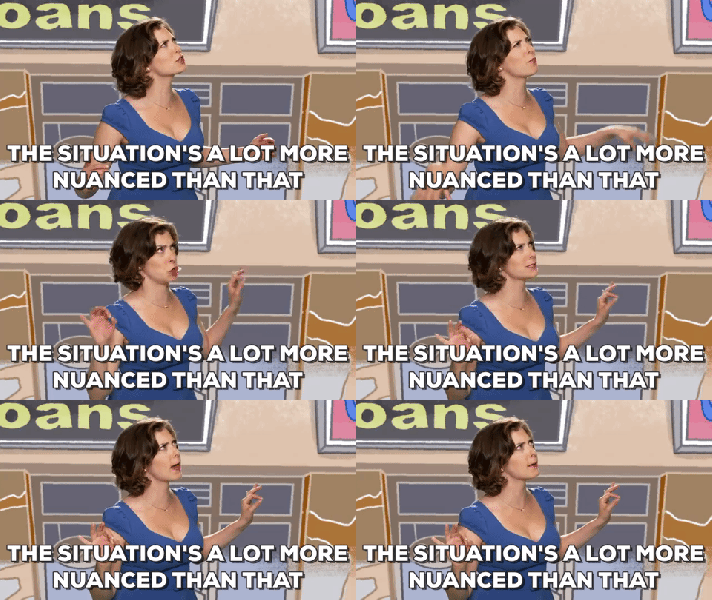
- Discuss the institutionalized racism presented in the novel. Pay particular attention to Maverick's speech to Starr about the ways society unintentionally creates a situation it is nearly impossible to escape: "'Corporate America don't bring jobs to our communities, and they damn sure ain't quick to hire us. Then, shit, even if you do have a high school diploma, so many of the schools in our neighborhoods don't prepare us well enough. That's why when your momma talked about sending you and your brothers to Williamson, I agreed. Our schools don't get the resources to equip you like Williamson does. It's easier to find some crack than it is to find a good school around here'" (169). He goes on to explain the cycle of drug dependence and concludes that "'That's the hate they're giving us, baby, a system designed against us. That's Thug Life. […] It's easier to fall into that life than it is to stay outta it, especially in a situation like [Khalil's]'" (170). Discuss the way the system affects various characters, and the different relationships they have to their privilege. Consider that Maverick is one of the few who did manage to break the cycle for himself (although he had to go to prison to do so) and his children, who have the opportunity to attend a better school, an opportunity that other people in their neighborhood don't get. Discuss THUG LIFE in general, using both Maverick and Khalil's explanations of what it means (Mav's on pg. 169, Khalil's on pg. 17).
-
 Discuss the difference between Garden Heights Starr and Williamson Starr. Which, if either, is more real? Does Starr have to put on an act for everyone in her life? Why does Starr have to regulate her behavior so strictly when she is around her white peers? What stereotypes is she afraid of playing into? How do Starr's white classmates—particularly Hailey—respond when Starr steps outside of the patterns of behavior that are deemed appropriate? Consider the language that Starr can and can't use in different situations; the way being black is, to a certain degree, considered cool; Hailey's response to Starr's occasional, passive activism; and the assumption that Starr should be dating Ryan, the other black kid in her grade. Consider Lisa's anger about Starr and Seven fighting because "'This is exactly what They expect you to do" (343). Consider: "I just have to be normal Starr at normal Williamson and have a normal day. That means flipping the switch in my brain so I'm Williamson Starr. Williamson Starr doesn't use slang—if a rapper would say it, she doesn't say it even if her white friends do. Slang makes them cool. Slang makes her 'hood.' Williamsson Starr holds her tongue when people piss her off so nobody will think she's the 'angry black girl.' Williamson Starr is approachable. No stank-eyes, side-eyes, none of that. Williamson Starr is unconfrontational. Basically, Williamson Starr doesn't give anyone a reason to call her ghetto" (71). Consider the fact that Starr describes Williamson Starr in the third person. In what ways is Starr punished for being black? Consider: "Funny how it works with white kids though. It's dope to be black until it's hard to be black" (11). Discuss the everyday concerns that consume Starr but that her white classmates do not have to be aware of. Also consider Starr's position as "the official representative of the black race" at her white high school (186).
 - What happens when Starr's worlds finally collide (359)?
- Discuss the presence of non-white, non-black characters in the novel, like Maya and Detective Gomez.
- Thomas directly tackles some of the most common defensive responses to claims of racism, including asking "Why does it always have to be about race with you?" (53), arguing that whites don't kill blacks as much as blacks kill blacks (53), not realizing that it is possible to do or say something racist without being a racist (112), falling into the trap of assuming that victims of police violence must have deserved what they got (341), and arguing that 'all lives matter' (see Hailey and Starr's argument on pg. 248: "'What's wrong with saying his life matters, too?' 'His life always matters more […] That's the problem!'").
- Discuss police brutality and the black protests of it. Why are people (both inside the novel and outside it) so hesitant to acknowledge black narratives about this issue? Is the question of police brutality black and white? Consider characters who do not necessarily fit the usual narrative, like Uncle Carlos, Chris, and the black officer who forced Maverick to the ground (193). Why is it important for a story like The Hate U Give to have characters who do not line up precisely the way they're expected to? Does it reframe the way you think about racism to realize that a black man can have internal biases against other black men? Does bias/racism have to be something intentional? Can someone be unaware of his/her own biases? Do you think that the police bias against blacks is personal (stemming from individuals) or institutional (stemming from the organization)?
- Discuss the investigation. Do you think that there was ever any chance that Officer Cruise would be convicted? Why or why not? Starr wonders if the investigation is "investigating or justifying" Khalil's death (102). What would need to have happened for Office Cruise to be punished? Why is the reputation of a white man considered more valuable than the life of a black man? Should it matter that the person killed was a drug dealer? Why does it? To whom does it matter? Consider Starr's assessment that "'I didn't know a dead person could be charged in his own murder'" and that "Khalil and I have been on trial since he died" (288, 333). Discuss Thomas' decision to make Khalil a drug dealer. How would the story have changed if he weren't? Would people have been able to find another justification for his murder? Does the murder feel less like murder because of Khalil's dealing? Why or why not?
- In addition to the usual sex talk, Starr and her siblings were given a talk about what to do if approached by the police (20). Is this typical? Were you given a talk about the police? Compare your experience with those of your peers. Is this sort of thing more or less likely in different racial groups?
- Discuss the distinction between condemning certain behavior (ie. Shooting unarmed black men) and condemning a whole group (ie. The police force). Starr explains that "'My uncle's a cop. I know not all cops are bad. And they risk their lives, you know? I'm always scared for my uncle. But I'm tired of them assuming. Especially when it comes to black people'" (289). Later, she reflects on the enthusiasm with which people are rapping 'Fuck the police': "I yell it out too. Part of me is like, 'What about Uncle Carlos the cop?' But this isn't about him or his coworkers who do their jobs right. This is about One-fifteen, those detectives with their bullshit questions, and those cops who made Daddy lie on the ground. Fuck them" (394). When protesting, Starr highlights the problem with essentializing a group of people: "I turn to the cops. 'I'm sick of this! Just like y'all think all of us are bad because of some people, we think the same about y'all. Until you give us a reason to think otherwise, we'll keep protesting'" (412). It is difficult to maintain moral superiority when you refuse to consider the other side's position. The Hate U Give presents cops like Carlos and cops like Cruise, protestors like Starr and protestors who become rioters. This makes an already difficult topic even more difficult. Why do you think Thomas chose to emphasize the messiness of the situation?
- Discuss family as it is presented in the novel. What does it mean to be a family? Is it significant that Starr does not have a traditional nuclear family? What makes a family? Is it blood? Experience? A combination? Starr's family includes people with a different parent (like Seven), people who are not technically related to her (like Kenya), people in different social classes (like Carlos), and people that are generally disliked (like Iesha). Discuss the circumstances of the Carter children's parentage, specifically Maverick's arrest and Carlos' fathering. What is the point of Starr seemingly having two dads? Which of the two men, Carlos or Maverick, is more fatherly? What does Starr mean when she says "I realized that 'Mommy' and 'Daddy' weren't just names, but they meant something" (119)? Contrast this with Starr's assessment of Miss Brenda being Khalil's momma "regardless" even though " 'She wasn't there for Khalil. You know how many times he cried about her? Birthdays, Christmas, all that. Why does she get to cry now?' […] She hasn't acted like a mom to him" (92, 91). Why is " 'carr[ying] that boy, birth[ing] that boy" enough to be a momma in some cases (92)?
- Discuss Kenya and Starr's conflict over Seven and the way that Kenya claims him as "my brother" because she feels that he would leave her half of the family if he could.
- Discuss Starr's relationships with various individual members of her family. How does her relationship with Uncle Carlos develop over the course of the novel? What about her relationship with Seven? With Kenya?
- Consider Starr's description of her neighborhood as a dysfunctional family (328).

Anyone else amused Archie Andrews is going to play Nick? Just me? Okay, then.
- Discuss Starr's religious beliefs. Starr and her family believe in "Black Jesus." Why is it important for Starr to continually reinforce her Jesus' blackness? Is this a reinforcement for Starr herself, or for The Hate U Give's audience. How does Starr's belief in God propel her to act the way that she does? Consider Officer's Cruise's cross— "a silver cross pendant hangs from his neck, like he's saying Jesus endorses what he did. We must believe in a different Jesus"—and Pastor Eldridge's belief that "Faith isn't just believing but taking steps toward that belief" (244, 211). Discuss the conflicts—both in the novel and outside it—caused by different interpretations of religion. Also discuss the way in which Starr's behavior is based on acts of faith and a desire to achieve her beliefs.
- Compare Khalil and DeVante. Is DeVante intended as a Khalil do-over (179)? What circumstances saved DeVante from following Khalil's path to the end? Discuss the Carters' relationships to DeVante and their willingness to go against King for him.
- Discuss Starr's response to Khalil's death. Why does she feel that she does not deserve to have been with him at the end? Why does she feel that she is stealing the sympathy from the people, like Ms. Rosalie and Khalil's friends, who deserve it? Would things have happened differently for Khalil if Starr and/or her family had been consistently there for him like they are for DeVante. Why does Starr feel partly responsible for Khalil's death?
-
 Discuss Starr's relationship with Chris. In what ways is theirs a typical teenage romance? In what ways is it different? Consider their families' concern about the relationship being interracial. Why is there a stigma attached to a black/white relationship that there doesn't seem to be with a black/black, white/white, or even black/Chinese relationship?
 - Starr eventually owns her voice, which is her "biggest weapon," after being afraid to speak out (410). Discuss the power of a voice. Early in the novel, speaking out—"snitching"—is portrayed negatively; Starr actively avoids knowledge of certain events because "you can't snitch if you don't know anything" (16) and Mr. Lewis is mocked and memed for his interview (189). As the narrative progresses, however, the emphasis changes. Maverick tells Starr that "We can't be silent" (171) and in the end King is taken down when everyone speaks out against him. Inspired by Starr, DeVante reclaims the word "snitch" by saying "'that lady said our voices are weapons. I should use mine, right? […] I already need the stitches. Might as well snitch" (430). Discuss the progression.
- One major roadblock to speaking out is fear. People fear retaliation. Starr says, "I've seen it happen over and over again: a black person gets killed just for being black, and all hell breaks loose. I've tweeted RIP hashtags, reblogged pictures on Tumblr, and signed every petition out there. I always said that if I saw it happen to somebody, I would have the loudest voice, making sure the world knew what went down. Now I am that person, and I'm too afraid to speak" (34-35). Why is Starr afraid to speak out? From whom does she fear hostility? What has to happen before Starr feels that speaking is worth the risk?

- Discuss the power words have in making something acceptable or unacceptable, particularly when they're used casually or just as a joke. Starr says, "That's the problem. We let people say stuff, and they say it so much that it becomes okay to them and normal for us. What's the point of having a voice if you're gonna be silent in those moments when you shouldn't be?" (252). How do you determine which moments need your voice and which don't? Which do you think is more harmful: casual, racist jokes that are seen as fine and funny or blatant racism? What different effects can each have?
- Discuss April Ofrah's role in bringing voices forward. Discuss her introduction, in which she gives a speech that concludes with, " 'Khalil was silenced, but let's join together and make our voices heard for him'" (129).
- Contrast the open discussion that can be used for positive change with the angry riots that "won't solve anything" (389). Keep in mind that Thomas never presents honesty as a surefire solution: Starr's testimony accomplishes nothing in the case against Office Cruise, and Lisa helps assuage Starr's guilt by reminding her that sometimes things go wrong even when you do everything right (154). What is the solution to a problem when doing things right and doing things wrong fails to accomplish anything?
- One major roadblock to speaking out is fear. People fear retaliation. Starr says, "I've seen it happen over and over again: a black person gets killed just for being black, and all hell breaks loose. I've tweeted RIP hashtags, reblogged pictures on Tumblr, and signed every petition out there. I always said that if I saw it happen to somebody, I would have the loudest voice, making sure the world knew what went down. Now I am that person, and I'm too afraid to speak" (34-35). Why is Starr afraid to speak out? From whom does she fear hostility? What has to happen before Starr feels that speaking is worth the risk?
- Discuss Starr's relationship with Hailey and Maya. What does Starr get out of her relationships with them? What eventually causes the falling out between Hailey and the other two? Discuss Starr and Maya's "minority alliance."
-
 Discuss the scene in which the three girls watch a basketball game that reinforces sexist gender roles. Hailey dives in, complaining about the "' 'play like a girl' mind-set the male gender uses to belittle women, when we have as much athleticism as they do'" (107). However, Hailey is not nearly as willing to go to bat against racism as she is for feminism, and she constantly dismisses Starr's concerns. Starr thinks, "Oh, so you can drag me to play basketball during one of your feminist rages, but you can't follow my Tumblr because of Emmett Till?" (108). Despite the fact that Hailey is able to see the disadvantage of a group she is a part of (women), she is blind to—and even perpetuates—the mistreatment of a disadvantaged group she is not a part of (people of color). Discuss the places where privilege overlaps, and discuss the presence—or absence—of other marginalized groups in the novel. Is it important for stories like this to acknowledge other areas of discrimination? If so, in what cases? If not, why not?
-
-
 Starr experienced the death of a friend long before Khalil died. Discuss what happened to Natasha. How did her death affect Starr? Remember that Maverick and Lisa sent Starr to Williamson after Natasha's death. How is Natasha's death different than Khalil's? Discuss how Starr processes and deals with her grief. Discuss: "See, that's why I hate it when somebody dies. People do stuff they wouldn't usually do" (36). How did Natasha's death change Starr? How does Khalil's? What things does Starr do after the deaths that she wouldn't normally do? How normal is death/gang violence in Garden Heights? How does it affect Starr and her family to live in a neighborhood where they're "used to gunshots" (136).
 - Discuss Garden Heights and the gang scene there. What is life like in Garden Heights? Why do people join gangs? How do they join? How do they get out once they've joined? Starr admits that Garden Heights is the ghetto, but she does not want her friends to say it (139). Gunshots are common (136). Ten year olds get gunned down. Good people like Maverick, Khalil, and DeVante get sucked into the life. Consider that Starr can't have her friends stay the night and that she admits to being ashamed of Garden Heights (441). Consider DeVante's explanation for joining the King Lords: "With King Lords, we had a whole bunch of folks who had our backs, no matter what. […] It was just cool to have somebody take care of us for a change, instead of the other way around" (238). Is there anything good about Starr's neighborhood? What?
- How can a situation like this be fixed? Consider Maverick's concern about schools in Garden Heights (quoted in 1.2). Can Garden Heights be fixed from the inside? From the outside? Maverick and Lisa send their kids to school outside Garden Heights and eventually move out despite Maverick's arguments that doing so would make them like "'all the other sellouts who leave and turn their backs on the neighborhood. We can change stuff around here, but instead we run?" (180). He presents it as if it were an either/or situation. What changes his mind? What is his compromise? Consider Mr. Lewis' insistence that Maverick rebuild his store after the riots because "'the neighborhood still needs more men like you. Even if you just running a store'" (439).
- Do you think that Khalil's story will have any wide impact? Officer Cruise was not convicted. Do you think that the next officer will be? Discuss this both in-universe and out. What impact has Starr had on her community? What impact has Angie Thomas had on her readers? Has The Hate U Give changed your perspective in any way? What impact do you see it having on people in general? What do you think will happen when the movie comes out and more people experience the story?
gif credits: Rebecca, Donna, Cas, Rebecca (again), Sam
Also, a sidenote: I'm slowly realizing that 99% of my reaction gifs are of white characters. I don't know if that is because of me or the shows I watch or of entertainment in general, but I am aware of it and will try to do better.
Source: https://funfandomblog.wordpress.com/2018/04/05/book-club-the-hate-u-give/
0 Response to "The Hate U Give Gif Funny"
Post a Comment