Short Loop From the Heart to the Lungs and Back Again Hypertension
Episode 011 Revision Podcast and A Deep Swoop Into The Center & Circulatory System
Here's what we talked about on today's FitPro Sessions Podcast
Today'south podcast episode is a revision Fit Pro session where Neale and I deep dive into the Heart & Circulatory System
We explain the function, the structure, and the three circulatory systems, as well as how this relates to training your client. Also, join us at the end for the revision ability hour.
Click the PLAY button beneath to heed to the unabridged episode
Grab the FitPro Sessions Podcast bear witness notes:
Timestamps:
1:00 Intro to Todays FitPro Session
ii:00 How many questions will I arrive my examination virtually Eye and Circulatory System?
iv:thirty How does learning the Heart & Circulatory System relate to preparation clients as a fitness professional?
6:00 The SAID Principle
10:30 Learning about all of the systems of the trunk
13:00 Understanding Anatomy so you can laissez passer on your knowledge
14:50 Spaced repetition in revision
17:00 What are the three claret vessels in the trunk?
17:xxx The three circulatory systems in the trunk
19:forty The function of the heart
20:xl Fun facts about the middle
23:00 Relating training approaches to the center & circulatory system
28:00 The center structure
29:l Understanding heart valves
33:thirty Arteries
36:00 Capillaries
38:00 Veins
41:10 What does the centre &Circulatory organisation do?
41:xl Relating the cognition dorsum to your clients
47:fifty Start of the Revision Power 60 minutes
The Revision Power Hr Crook Sheet:
The Heart and Circulatory System
The circulatory system is composed of the middle and claret vessels, including arteries, veins, and capillaries.
Iii CIRCULATORY SYSTEMS
Our bodies actually take iii circulatory systems: The pulmonary apportionment is a short loop from the heart to the lungs and back over again,
and the systemic apportionment (the system we unremarkably recollect of every bit our circulatory arrangement) sends blood from the heart to all the other parts of our bodies and back again.
The third three is the coronay circulatory organisation… which serves the middle muscle itself.
Part
The centre is the fundamental organ in the circulatory organization. Every bit a hollow, muscular pump, its main function is to propel blood throughout the body.
It usually beats from 60 to 100 times per minute, simply can become much faster when necessary. It beats nearly 100,000 times a day, more than than 30 one thousand thousand times per year, and most two.5 billion times in a 70-twelvemonth lifetime.
Fun fact 1: During the average lifetime, a centre pumps 1 million barrels of blood, enough to fill up more than 3 super tankers.
Fun fact 2: The heart pumps near 100 gallons of blood through the body each hour – plenty to fill i,600 drinking glasses.
Fun fact 3: A newborn baby has about one cup of blood in apportionment. An adult man has about iv to five litres.
Fun fact 4: Blood takes near 20 seconds to circulate through the entire vascular system. Claret makes up seven % of your body weight.
Fun fact v: Every year, your heart beats approximately 35 million times. That is 100,000 beats per twenty-four hour period and 70 beats per infinitesimal.
The eye gets messages from the body that tells it when to pump more than or less claret depending on an private'south needs.
Stick with that for a 2d…
Center RELATING TO PLANNING
Depending on FITT – at that place is an astute change in the client'southward HR.
This impacts our client's enjoyment, feelings and adherence. This in turn impacts their goal outcome.
Must exist a smart science-backed approach to planning and delivery of a session and periodized plan.
Conversely, when nosotros're sleeping, it pumps just enough to provide for the lower amounts of oxygen needed past our bodies at rest.
HEART STRUCTURE
The heart has four chambers that are enclosed by thick, muscular walls. It lies between the lungs and simply to the left of the middle of the breast cavity.
The bottom part of the middle is divided into ii chambers chosen the correct and left ventricles, which pump blood out of the heart. A wall called the interventricular septum divides the ventricles.
The upper function of the middle is fabricated upwardly of the other two chambers of the heart, the right and left atria. The correct and left atria receive the blood entering the heart.
A wall called the interatrial septum divides the right and left atria, which are separated from the ventricles by the atrioventricular valves.
The tricuspid valve separates the correct atrium from the correct ventricle, and the mitral or bicuspid valve separates the left atrium and the left ventricle.
Two other cardiac valves separate the ventricles and the big claret vessels that carry claret leaving the heart.
These are the pulmonary valve, which separates the right ventricle from the pulmonary artery leading to the lungs, and the aortic valve, which separates the left ventricle from the aorta, the body's largest blood vessel.
ARTERIES
Arteries deport blood away from the heart. A for away.
They are the thickest blood vessels, with muscular walls that contract to keep the blood moving away from the center and through the body.
In the systemic circulation, oxygen-rich blood is pumped from the eye into the aorta.
This huge artery curves up and dorsum from the left ventricle, then heads down in front end of the spinal column into the abdomen. Two coronary arteries branch off at the commencement of the aorta and divide into a network of smaller arteries that provide oxygen and nourishment to the muscles of the middle….
aka. Coronary avenue.
Unlike the aorta, the body's other main avenue, the pulmonary artery, carries oxygen-poor blood. From the right ventricle, the pulmonary artery divides into right and left branches, on the way to the lungs where blood picks upward oxygen.
Equally they go farther from the heart, the arteries branch out into arterioles, which are smaller and less elastic.
CAPILLARIES
Claret flowed from the arterioles into capillaries.
Though tiny, the capillaries are one of the most important parts of the circulatory system because it'south through them that nutrients and oxygen are delivered to the cells. In addition, waste products such as carbon dioxide are as well removed by the capillaries.
A network of tiny capillaries connects the arteries and veins.
VEINS
Veins carry claret back to the centre. VeIN – has the word IN within information technology, so it is sending claret INTO the heart to be pumped
Veins are not as muscular as arteries, but they contain valves that prevent blood from flowing backward. Veins have the same iii layers that arteries practise, but are thinner and less flexible.
Capillaries lead into the smallest venules, and so veins, then the two largest veins are the superior and inferior vena cavae.
The terms superior and inferior doesn't mean that one vein is amend than the other, simply that they're located in a higher place and below the middle.
What the Eye and Circulatory System Practise
The circulatory organization works closely with other systems in our bodies. It supplies oxygen and nutrients to our bodies by working with the respiratory system.
At the same fourth dimension, the circulatory arrangement helps carry waste and carbon dioxide out of the body.
Let's go dorsum to FRED
When he is running at higher intensities, the amount of CO2 and waste products Fred creates will exist greater. This means that his animate rate goes up, and his heart charge per unit has to increase to get rid of all of the waste.
Similarly the intensity and duration that Fred is running will bear upon his Hormones — produced by the endocrine organisation
Our hormones are transported through the blood in the circulatory system. As the body's chemical messengers, hormones transfer data and instructions from one ready of cells to another. For example, i of the hormones produced by the heart helps command the kidneys' release of salt from the body.
So when Fred is running he volition sweat out common salt and other electrolytes, and to help maintain homeostasis the kidneys release more than salt.
Summary
It's not simply about the viii question in your examination – more so,
How this A&P topic impacts y'all working safely and effectively clients in the time to come.
Eye & Circulatory Organization Mock Questions
Test your noesis by answering these three mock questions: answers are at the bottom of the blog.
Q1: Which of the post-obit blood vessels take blood away from the heart towards the working muscles
A. Veins
B. Capillaries
C. Arteries
D. Vena cavae
Q2: Which of the following is a proper noun given to the circulatory system that carries blood to the center musculus?
A. Systemic Arrangement
B. Pulmonary System
C. Coronary System
D. Somatic System
Q3: What is the part of the left ventricle?
A. Pump blood via the aorta to the working muscles
B. Pump blood via the Pulmonary Artery to the lungs
C. Collect claret from the lungs
D. Pump blood via the pulmonary avenue to the working muscles
Test your cognition, by reading the answers beneath.
Download More than Mock Questions for FREE just link these by clicking this link:MOCK QUESTIONS

ANSWERS
Q1 = C
Q2 = C
Q3 = A
Need more help?
Discover How 6500+ Fitpros In Training Are Walking Into Their Exam With Confidence And Guaranteeing A Laissez passer
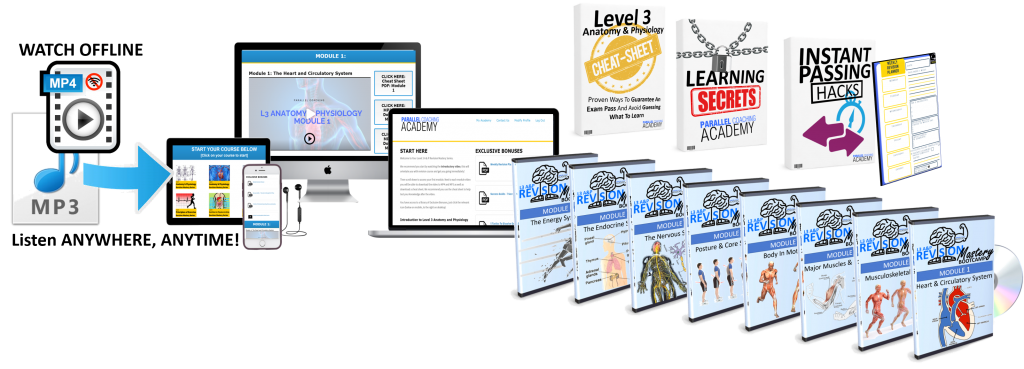
Y'all get a video and crook sheet for each of the modules in your Anatomy and Physiology.
Are yous tired of spending hours reading from a manual or clunky online learning that finds you clicking through slides leaving you understanding nothing?
Research shows that relying on this quondam mode of learning isn't enough to guarantee a laissez passer, let alone feel confident walking into your Level 3 A&P examination.
The revision mastery Bootcamp takes your revision to the next level.
You lot will larn via structured video tutorials, cheat sheets and audio downloads…it's just like having a 121 tutor on your phone or laptop, ANYWHERE, anytime.
Only this way, y'all won't fall asleep whilst revising and y'all'll actually learn to enjoy anatomy.
This is not another course with more exams –it HELPS pass the course yous're already enrolled on!
"EVERYTHING You Need To Learn, Revise And Pass Your Level 3 Anatomy & Physiology Exam"
If you want to go your revision structured, learn everything y'all need to know and experience confident on exam day, then click the link below:
https://revision.parallelcoaching.co.uk/l3ap-revision-mastery-bootcamp-13
Encounter you lot on the inside
Defended to More
Hayley "Heart & Circulatory System" Bergman
Parallel Coaching
P.S. You can likewise discover us on the following platforms:
Instagram: https://world wide web.instagram.com/parallelcoaching
Facebook: https://www.facebook.com/ParallelCoaching
Twitter: https://twitter.com/ParallelCoach
YouTube: http://flake.ly/2F1Z1bs
Comments
Source: https://parallelcoaching.co.uk/episode-011-revision-heart-and-circulatory-system
0 Response to "Short Loop From the Heart to the Lungs and Back Again Hypertension"
Post a Comment