what is the name of a technique used to open the airway
| Airway management | |
|---|---|
 Photo of an anesthesiologist using the Glidescope video laryngoscope to intubate the trachea of a morbidly obese elderly person with challenging airway anatomy | |
| MeSH | D058109 |
Airway direction includes a set of maneuvers and medical procedures performed to prevent and relieve airway obstruction. This ensures an open pathway for gas exchange between a patient's lungs and the atmosphere.[1] This is accomplished by either clearing a previously obstructed airway; or by preventing airway obstacle in cases such as anaphylaxis, the obtunded patient, or medical sedation. Airway obstruction can be caused by the tongue, foreign objects, the tissues of the airway itself, and bodily fluids such as claret and gastric contents (aspiration).[ citation needed ]
Airway management is commonly divided into two categories: basic and advanced.
Basic techniques are generally non-invasive and do non require specialized medical equipment or advanced preparation. These include head and neck maneuvers to optimize ventilation, abdominal thrusts, and back blows.
Advanced techniques require specialized medical training and equipment, and are further categorized anatomically into supraglottic devices (such as oropharyngeal and nasopharyngeal airways), infraglottic techniques (such as tracheal intubation), and surgical methods (such every bit cricothyrotomy and tracheotomy).[ii]
Airway management is a primary consideration in the fields of cardiopulmonary resuscitation, anaesthesia, emergency medicine, intensive care medicine, neonatology, and start aid. The "A" in the ABC handling mnemonic is for airway.[3]
Basic airway direction [edit]
Basic airway management involves maneuvers that do not crave specialized medical equipment (in contrast to avant-garde airway management). It is mainly used in first aid since it is not-invasive, quick, and relatively simple to perform. The simplest fashion to determine if the airway is obstructed is by assessing whether the patient is able to speak.[4] Basic airway management tin can be divided into treatment and prevention of an obstruction in the airway.

Back slaps and intestinal thrusts are performed to relieve airway obstacle by foreign objects

Inwards and upward strength during abdominal thrusts
[ citation needed ]
Treatment [edit]
Treatment includes different maneuvers that aim to remove the foreign body that is obstructing the airway. This type of obstacle most oft occurs when someone is eating or drinking. About modern protocols, including those of the American Heart Association, American Ruddy Cross and the European Resuscitation Council,[v] recommend several stages, designed to apply increasingly more than pressure. Nearly protocols recommend first encouraging the victims to coughing, and allowing them an opportunity to spontaneously articulate the foreign body if they are coughing forcefully. If the person's airway continues to exist blocked, more than forceful maneuvers such as hard back slaps and abdominal thrusts (Heimlich maneuver) tin can be performed. Some guidelines recommend alternating between abdominal thrusts and back slaps while others recommend the same starting with the dorsum slaps outset.[5] Having the person lean forwards reduces the chances of the strange body going back down the airway when coming upward.[6]
Performing abdominal thrusts on someone else involves standing behind them, and providing inward and upwards forceful compressions in the upper belly, concretely in the surface area located between the chest and the omphalos. The rescuer usually gives the compressions using a fist that is grasped with the other hand.[ citation needed ]
Abdominal thrusts can likewise be performed on oneself with the aid of the objects near, for example: past leaning over a chair. Anyway, when the choking victim is oneself, i of the more reliable options is the usage of whatever specific anti-choking device. In adults, there is express evidence that the head down position tin be used for cocky-treatment of suffocation and appears to be an option only if other maneuvers do non piece of work.[7] In contrast, in children under 1 it is recommended that the child be placed in a caput down position every bit this appears to help increase the effectiveness of dorsum slaps and abdominal thrusts.[8]
When the victim can non receive pressures on the abdomen (it tin can happen in case of pregnancy or excessive obesity, for example), chest thrusts are brash instead of intestinal thrusts. The chest thrusts are the aforementioned blazon of compressions but applied on the lower half of the breast os (not in the very extreme, which is a signal named xiphoid process and could be broken).
The American Medical Clan and Australian Resuscitation Council abet sweeping the fingers across the dorsum of the throat to attempt to dislodge airway obstructions, once the choking victim becomes unconscious.[9] [ten] Nevertheless, many modern protocols and literature recommend confronting the use of the finger sweep.[11] If the person is witting, they should be able to remove the foreign object themselves, and if they are unconscious, a finger sweep can crusade more harm. A finger sweep can push the foreign trunk further downwardly the airway, making information technology harder to remove, or cause aspiration by inducing the person to vomit. Additionally, in that location is the potential for harm to the rescuer if they are unable to clearly see the oral cavity (for instance, cutting a finger on jagged teeth).
Prevention [edit]


The jaw thrust maneuver tin can also open up up the airway with minimal spine manipulation
Prevention techniques focus on preventing airway obstruction by the tongue and reducing the likelihood of aspiration of stomach contents or claret. The head-tilt/chin-lift and jaw-thrust maneuvers are useful for the former while the recovery position is useful for the latter. If head-tilt/chin-lift and jaw-thrust maneuvers are performed with whatsoever objects in the airways it may dislodge them further down the airways and thereby cause more blockage and harder removal.[ citation needed ]
The head-tilt/chin-lift is the primary maneuver used in whatever patient in whom cervical spine injury is non a business organisation. This maneuver involves flexion of the neck and extension of the head at Atlanto-occipital joint (besides called the sniffing position), which opens upward the airway by lifting the tongue abroad from the back of the throat. Placing a folded towel behind the caput accomplishes the same result.[iv]

All forms of the recovery position share basic principles. The head is in a dependent position so that fluid can drain from the patient's airway; the mentum is well upwardly to keep the epiglottis opened. Arms and legs are locked to stabilize the position of the patient
The jaw-thrust maneuver is an effective airway technique, particularly in the patient in whom cervical spine injury is a concern. It is easiest when the patient is positioned supine. The practitioner places their alphabetize and middle fingers backside the bending of the mandible to physically push the posterior aspects of the mandible upwards while their thumbs push down on the chin to open the mouth. When the mandible is displaced forward, it pulls the tongue forward and prevents it from occluding the entrance to the trachea.[12]
The recovery position is an of import prevention technique for an unconscious person that is breathing casually. This position entails having the person lie in a stable position on their side with the head in a dependent position and so fluids practise not bleed downward the airway, reducing the risk of aspiration.[6]
Most airway maneuvers are associated with some movement of the cervical spine.[13] [xiv] When there is a possibility of cervical injury, collars are used to assist concur the head in-line. Most of these airway maneuvers are associated with some movement of the cervical spine. Fifty-fifty though cervical collars tin can cause issues maintaining an airway and maintaining a claret pressure,[15] information technology is not recommended to remove the neckband without adequate personnel to manually concord the head in identify.[16]
Advanced airway direction [edit]
In contrast to basic airway management maneuvers such equally head-tilt or jaw-thrust, avant-garde airway direction relies on the employ of medical equipment. Advanced airway management tin can be performed "blindly" or with visualization of the glottis by using a laryngoscope. Advanced airway management is frequently performed in the critically injured, those with extensive pulmonary disease, or anesthetized patients to facilitate oxygenation and mechanical ventilation. Additionally, implementation of a cuffing system is used to foreclose the possibility of asphyxiation or airway obstruction.[17]
Many methods are used in Avant-garde airway management. Examples in increasing lodge of invasiveness include the use of supraglottic devices such equally oropharyngeal or nasopharyngeal airways, infraglottic techniques such as tracheal intubation and finally surgical methods.[18] [xix]
Removal of foreign objects [edit]

Foreign objects tin can be removed with a Magill forceps under inspection of the airway with a laryngoscope
The ingestion and aspiration of strange objects pose a common and unsafe problem in immature children. Information technology remains one of the leading cause of death in children under the age of v.[20] Common nutrient items (baby carrots, peanuts, etc.) and household objects (coins, metals, etc.) may social club in diverse levels of the airway tract and cause meaning obstruction of the airway. Complete obstruction of the airway represents a medical emergency. During such crisis, caretakers may effort dorsum blows, abdominal thrust, or the Heimlich maneuver to dislodge the inhaled object and reestablish airflow into the lungs.[21]
In the hospital setting, healthcare practitioners volition make the diagnosis of foreign torso aspiration from the medical history and physical exam findings. In some cases, providers volition order chest radiographs, which may show signs of air-trapping in the affected lung. In advanced airway management, the inhaled foreign objects, notwithstanding, are either removed past using a simple plastic suction device (such as a Yankauer suction tip) or under direct inspection of the airway with a laryngoscope or bronchoscope. If removal is not possible, other surgical methods should be considered.[22]
Supraglottic techniques [edit]
Supraglottic techniques use devices that are designed to have the distal tip resting in a higher place the level of the glottis when in its final seated position. Supraglottic devices ensure patency of the upper respiratory tract without entry into the trachea by bridging the oral and pharyngeal spaces.[17] At that place are many methods of subcategorizing this family unit of devices including route of insertion, absence or presence of a gage, and anatomic location of the device's distal terminate. The most normally used devices are laryngeal masks and supraglottic tubes, such as oropharyngeal (OPA) and nasopharyngeal airways (NPA).[17] In general, features of an platonic supraglottic airway include the ability to bypass the upper airway, produce depression airway resistance, allow both positive force per unit area besides as spontaneous ventilation, protect the respiratory tract from gastric and nasal secretions, be easily inserted past fifty-fifty a nonspecialist, produce high first-time insertion rate, remain in place once in seated position, minimize take a chance of aspiration, and produce minimal side furnishings.[17]
A nasopharyngeal airway is a soft safe or plastic tube that is passed through the nose and into the posterior pharynx. Nasopharyngeal airways are produced in various lengths and diameters to accommodate for gender and anatomical variations. Functionally, the device is gently inserted through a patient'southward olfactory organ later careful lubrication with a viscous lidocaine gel. Successful placement will facilitate spontaneous ventilation, masked ventilation, or machine assisted ventilation with a modified nasopharyngeal airway designed with special attachments at the proximal cease. Patients mostly tolerate NPAs very well. NPAs are preferred over OPAs when the patient's jaw is clenched or if the patient is semiconscious and cannot tolerate an OPA.[23] NPAs, however, are generally not recommended if at that place is suspicion of a fracture to the base of operations of the skull. In these circumstances, insertion of the NPA can cause neurological damage by entering the attic during placement.[23] In that location is no consensus, however, regarding the risk of neurological damage secondary to a basilar skull fracture compared to hypoxia due to bereft airway management.[24] [25] Other complications of Nasopharyngeal airways employ includes laryngospasm, epistaxis, airsickness, and tissue necrosis with prolonged use.[17]
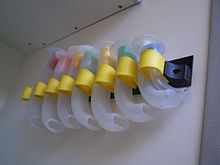
Oropharyngeal airways in a range of sizes
Oropharyngeal airways are curved, rigid plastic devices, inserted into the patient'southward rima oris. Oropharyngeal airways are produced in various lengths and diameters to accommodate for gender and anatomical variations. Information technology is especially useful in patients with excessive natural language and other soft tissues. OPAs forestall airway obstruction by ensuring that the patient's tongue does not obstruct the epiglottis by creating a conduit. Because an oropharyngeal airway can mechanically stimulate the gag reflex, information technology should merely be used in a deeply sedated or unresponsive patient to avert vomiting and aspiration.[26] Careful attention must be fabricated while inserting an OPA. The user must avoid pushing the tongue further downward the patient's throat. This is usually washed by inserting the OPA with its bend facing cephalad and rotating it 180 degrees as you enter the posterior throat.[18]
Extraglottic devices are another family unit of supraglottic devices that are inserted through the mouth to sit on top of the larynx. [27] Extraglottic devices are used in the bulk of operative procedures performed under general anaesthesia.[28] Compared to a cuffed tracheal tube, extraglottic devices provide less protection against aspiration but are more easily inserted and causes less laryngeal trauma.[27] Limitations of extraglottic devices arise in morbidly obese patients, lengthy surgical procedures, surgery involving the airways, laparoscopic procedures and others due to its bulkier design and inferior power to prevent aspiration.[29] In these circumstances, endotracheal intubation is generally preferred. The nigh commonly used extraglottic device is the laryngeal mask airway (LMA). An LMA is a cuffed perilaryngeal sealer that is inserted into the mouth and set over the glottis. Once it is in its seated position, the cuff is inflated.[30] Other variations include devices with oesophageal access ports, so that a carve up tube tin can exist inserted from the mouth to the stomach to decompress accumulated gases and bleed liquid contents.[27] Other variations of the device tin take an endotracheal tube passed through the LMA and into the trachea.[27]
Infraglottic techniques [edit]

A cuffed endotracheal tube used in tracheal intubation
In contrast to supraglottic devices, infraglottic devices create a conduit between the mouth, passing through the glottis, and into the trachea. There are many infraglottic methods bachelor and the chosen technique is reliant on the accessibility of medical equipment, competence of the clinician and the patient'south injury or disease. Tracheal intubation, oftentimes simply referred to every bit intubation, is the placement of a flexible plastic or condom tube into the trachea to maintain an open airway or to serve as a conduit through which to administrate certain drugs.[30] The most widely used route is orotracheal, in which an endotracheal tube is passed through the mouth and vocal apparatus into the trachea. In a nasotracheal procedure, an endotracheal tube is passed through the olfactory organ and vocal apparatus into the trachea. Alternatives to standard endotracheal tubes include laryngeal tube and combitube.[ citation needed ]
Surgical methods [edit]

Photograph of a tracheostomy tube
Surgical methods for airway direction rely on making a surgical incision below the glottis in order to achieve direct access to the lower respiratory tract, bypassing the upper respiratory tract. Surgical airway management is often performed as a last resort in cases where orotracheal and nasotracheal intubation are impossible or contraindicated. Surgical airway management is too used when a person volition demand a mechanical ventilator for a longer period. Surgical methods for airway management include cricothyrotomy and tracheostomy.[ citation needed ]
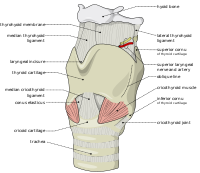
A cricothyrotomy is an emergency surgical procedure in which an incision is made through the cricothyroid membrane to establish a patent airway during certain life-threatening situations, such every bit airway obstacle by a strange body, angioedema, or massive facial trauma.[31] Cricothyrotomy is much easier and quicker to perform than tracheotomy, does not crave manipulation of the cervical spine and is associated with fewer firsthand complications.[32] Some complications of cricothyrotomy include bleeding, infection, and injury to surrounding skin and soft tissue structures.
A tracheotomy is a surgical procedure in which a surgeon makes incision in the neck and a breathing tube is inserted directly into the trachea.[33] A mutual reason for performing a tracheotomy includes requiring to be put on a mechanical ventilator for a longer period.[33] The advantages of a tracheotomy include less risk of infection and impairment to the trachea during the immediate post-surgical catamenia.[33] Although rare, some long term complications of tracheotomies include tracheal stenosis and tracheoinnominate fistulas.[34]
Airway management in specific situations [edit]
Cardiopulmonary resuscitation [edit]
The optimal method of airway management during CPR is not well established at this fourth dimension given that the majority of studies on the topic are observational in nature. These studies, however, guide recommendations until prospective, randomized controlled trials are conducted.[ citation needed ]
Current evidence suggests that for out-of-hospital cardiac arrest, basic airway interventions (head-tilt–mentum-lift maneuvers, purse-valve-masking or mouth-to-mouth ventilations, nasopharyngeal and/or oropharyngeal airways) resulted in greater brusque-term and long-term survival, besides every bit improved neurological outcomes in comparison to advanced airway interventions (endotracheal intubation, laryngeal mask airway, all types of supraglottic airways (SGA), and trans-tracheal or trans-cricothyroid membrane airways).[35] [36] Given that these are observational studies, caution must exist given to the possibility of confounding by indication. That is, patients requiring an advanced airway may take had a poorer prognosis in relation to those requiring basic interventions to brainstorm with.
For the management of in-hospital cardiac arrest yet, studies currently support the establishment of an advanced airway. It is well documented that quality chest compressions with minimal interruption issue in improved survival.[37] This is suggested to be due, in part, to decreased no-catamenia-time in which vital organs, including the heart are not adequately perfused. Institution of an advanced airway (endotracheal tube, laryngeal mask airway) allows for asynchronous ventilation, reducing the no-menstruation ratio, as compared to the basic airway (bag-valve mask) for which compressions must be paused to fairly ventilate the patient.[38]
Bystanders without medical training who see an individual suddenly collapse should call for help and begin breast compressions immediately. The American Heart Clan currently supports "Hands-only"™ CPR, which advocates chest compressions without rescue breaths for teens or adults.[39] This is to minimize the reluctance to showtime CPR due to business concern for having to provide oral cavity-to-mouth resuscitation.[ citation needed ]
Trauma [edit]

Purse-valve mask ventilation.
Airway represents the "A" in the ABC mnemonic for trauma resuscitation.
Direction of the airway in trauma can be especially complicated, and is dependent on the mechanism, location, and severity of injury to the airway and its surrounding tissues. Injuries to the cervical spine, traumatic disruption of the airway itself, edema in the setting of caustic or thermal trauma, and the combative patient are examples of scenarios a provider may need to accept into account in assessing the urgency of securing an airway and the means of doing so.[xl] [41]
The pre-hospital setting provides unique challenges to management of the airway including tight spaces, neck immobilization, poor lighting, and often the added complexity of attempting procedures during send. When possible, basic airway management should be prioritized including head-tilt-chin-lift maneuvers, and bag-valve masking. If ineffective, a supraglottic airway can exist utilized to aid in oxygenation and maintenance of a patent airway. An oropharyngeal airway is acceptable, withal nasopharyngeal airways should exist avoided in trauma, specially if a basilar skull fracture is suspected.[42] Endotracheal intubation carries with it many risks, particularly when paralytics are used, equally maintenance of the airway becomes a challenge if intubation fails. It should therefore be attempted by experienced personnel, merely when less invasive methods fail or when it is deemed necessary for prophylactic send of the patient, to reduce risk of failure and the associated increment in morbidity and mortality due to hypoxia.[43] [44]

Laryngeal mask airway (LMA). Case of a supraglottic device.
Direction of the airway in the emergency department is optimal given the presence of trained personnel from multiple specialties, as well as access to "difficult airway equipment" (videolaryngoscopy, eschmann tracheal tube introducer, fiberoptic bronchoscopy, surgical methods, etc.).[iv] Of primary concern is the status and patency of the maxillofacial structures, larynx, trachea, and bronchi as these are all components of the respiratory tract and failure anywhere along this path may impede ventilation. Excessive facial hair, severe burns, and maxillofacial trauma may prevent conquering of a good mask seal, rendering bag-valve mask ventilation hard. Edema of the airway can make laryngoscopy difficult, and therefore in those with suspected thermal burns, intubation is recommended in attempts to speedily secure an airway prior to progression of the swelling.[45] Furthermore, blood and vomitus in the airway may prove visualization of the song cords difficult rendering directly and video laryngoscopy, as well equally fiberoptic bronchoscopy challenging.[46] Establishment of a surgical airway is challenging in the setting of restricted cervix extension (such as in a c-collar), laryngotracheal disruption, or distortion of the anatomy by a penetrating forcefulness or hematoma. Tracheotomy in the operating room by trained professionals is recommended over cricothyroidotomy in the case of complete laryngotracheal disruption or children under the historic period of 12.[47]
See also [edit]
- Choking, Kickoff-Aid treatment
References [edit]
- ^ Bingham, Robert G.; Proctor, Lester T. (2008-08-01). "Airway direction". Pediatric Clinics of North America. 55 (4): 873–886, ix–x. doi:10.1016/j.pcl.2008.04.004. ISSN 0031-3955. PMID 18675024.
- ^ Tintinalli, Judith (2016). Tintinalli'due south Emergency Medicine: A Comprehensive Study Guide. McGraw Hill. pp. 178–198. ISBN 978-0-07-180913-9
- ^ Wright, Pearce (2003-08-13). "Obituary: Peter Safar". London: The Guardian. Retrieved 2014-12-06
- ^ a b c Tintinalli, Judith (2016). Tintinalli'south Emergency Medicine: A Comprehensive Written report Guide, 8th edition. Mc-Graw Hill. pp. Ch 28. ISBN978-0071794763.
- ^ a b Nolan, JP; Soar, J; Zideman, DA; Biarent, D; Bossaert, LL; Deakin, C; Koster, RW; Wyllie, J; Böttiger, B; ERC Guidelines Writing Group (2010). "European Resuscitation Council Guidelines for Resuscitation 2010 Section 1. Executive summary". Resuscitation. 81 (x): 1219–76. doi:10.1016/j.resuscitation.2010.08.021. hdl:10067/1302980151162165141. PMID 20956052.
- ^ a b "European Resuscitation Council Guidelines for Resuscitation 2010 Section 2. Adult basic life support and utilise of automated external defibrillators - Article in Motion". resuscitation-guidelines.articleinmotion.com. Archived from the original on 2016-05-29. Retrieved 2016-12-06 .
- ^ Luczak, Artur (June 2016). "Head-down self-treatment of choking". Resuscitation. 103: e13. doi:10.1016/j.resuscitation.2016.02.015. PMID 26923159.
- ^ Maconochie, Ian (2015). "European Resuscitation Quango Guidelines for Resuscitation 2015". Resuscitation. 95: 223–248. doi:10.1016/j.resuscitation.2015.07.028. PMID 26477414.
- ^ American Medical Association (2009-05-05). American Medical Association Handbook of Offset Aid and Emergency Care. Random House. ISBN978-i-4000-0712-seven.
- ^ "Finger Sweep". resus.org.au . Retrieved 2018-02-04 .
- ^ Vunda, Aaron; Vandertuin, Lynda (2012). "Nasopharyngeal Foreign Body following a Blind Finger Sweep". The Periodical of Pediatrics. 160 (2): 353. doi:10.1016/j.jpeds.2011.08.061. PMID 22014606.
- ^ Burtenshaw, Andrew (2015). Emergency Airway Management. Cambridge University Press. pp. 22–23. ISBN978-1107661257.
- ^ Donaldson WF, Heil BV, Donaldson VP, Silvaggio VJ (1997). "The effect of airway maneuvers on the unstable C1-C2 segment. A cadaver study". Spine. 22 (11): 1215–8. doi:ten.1097/00007632-199706010-00008. PMID 9201858. S2CID 28174117.
- ^ Brimacombe J, Keller C, Künzel KH, Gaber O, Boehler M, Pühringer F (2000). "Cervical spine movement during airway management: a cinefluoroscopic report of the posteriorly destabilized third cervical vertebrae in human cadavers". Anesth Analg. 91 (5): 1274–viii. doi:ten.1213/00000539-200011000-00041. PMID 11049921. S2CID 32473385.
- ^ Kolb JC, Summers RL, Galli RL (1999). "Cervical collar-induced changes in intracranial force per unit area". Am J Emerg Med. 17 (2): 135–7. doi:ten.1016/S0735-6757(99)90044-X. PMID 10102310.
- ^ Mobbs RJ, Stoodley MA, Fuller J (2002). "Effect of cervical hard collar on intracranial pressure level after head injury". ANZ J Surg. 72 (6): 389–91. doi:ten.1046/j.1445-2197.2002.02462.x. PMID 12121154. S2CID 33930416.
- ^ a b c d e Finucane, Brendan T.; Tsui, Ban Chi-Ho; Santora, Albert H. (2011-01-01). Principles of airway management (4th ed.). New York: Springer. doi:10.1007/978-0-387-09558-five. ISBN9780387095585.
- ^ a b "UpToDate". www.uptodate.com.
- ^ "UpToDate". www.uptodate.com.
- ^ "National Safety Council Accident Facts". February 2000.
- ^ Manning PB, Wesley JR, Polley TZ, et al. Esophageal and tracheobronchial foreign bodies in infants and children. Pediatr Surg Int 1987;2:346.
- ^ TONY CAPIZZANI; RONALD B. HIRSCHL; ROBERT Due east. CILLEY (2011). Greenfield's Surgery: Scientific Principles and Do, 5e. Lippincott Williams & Wilkins. pp. Chapter 2016 (Pediatric Chest).
- ^ a b Roberts K, Whalley H, Bleetman A (2005). "The nasopharyngeal airway: dispelling myths and establishing the facts". Emerg Med J. 22 (six): 394–6. doi:x.1136/emj.2004.021402. PMC1726817. PMID 15911941.
- ^ Ellis, D. Y. (2006). "Intracranial placement of nasopharyngeal airways: Is it all that rare?". Emergency Medicine Journal. 23 (8): 661. doi:ten.1136/emj.2006.036541. PMC2564185. PMID 16858116.
- ^ Roberts, K.; Whalley, H.; Bleetman, A. (2005). "The nasopharyngeal airway: Dispelling myths and establishing the facts". Emergency Medicine Journal. 22 (vi): 394–396. doi:10.1136/emj.2004.021402. PMC1726817. PMID 15911941.
- ^ "Guedel airway". AnaesthesiaUK. fourteen May 2010. Archived from the original on 24 January 2013. Retrieved 23 May 2013.
- ^ a b c d Hernandez, MR; Klock, Andranik; Ovassapian, A (2011). "Evolution of the Extraglottic Airway: A Review of Its History, Applications, and Practical Tips for Success". Anesthesia and Analgesia. 114 (2): 349–68. doi:ten.1213/I.0b013e31823b6748. PMID 22178627. S2CID 14421707.
- ^ Cook, T; Howes, B. (2010). "Supraglottic airway devices: recent advances". Continuing Education in Anaesthesia, Disquisitional Intendance and Pain. 11 (two): 56–61. doi:10.1093/bjaceaccp/mkq058. S2CID 49413173.
- ^ Davies PR, Tighe SQ, Greenslade GL, Evans GH (1990). "Laryngeal mask airway and tracheal tube insertion by unskilled personnel". The Lancet. 336 (8721): 977–979. doi:ten.1016/0140-6736(90)92429-L. PMID 1978159. S2CID 30763681. Retrieved 25 July 2010.
- ^ a b Thierbach, Andreas R.; Werner, Christian (2005-12-01). "Infraglottic airway devices and techniques". Best Do & Research. Clinical Anaesthesiology. xix (four): 595–609. doi:10.1016/j.bpa.2005.06.001. ISSN 1521-6896. PMID 16408536.
- ^ Mohan, R; Iyer, R; Thaller, S (2009). "Airway management in patients with facial trauma". Journal of Craniofacial Surgery. 20 (1): 21–3. doi:10.1097/SCS.0b013e318190327a. PMID 19164982. S2CID 5459569.
- ^ Katos, MG; Goldenberg, D (2007). "Emergency cricothyrotomy". Operative Techniques in Otolaryngology. xviii (2): 110–4. doi:10.1016/j.otot.2007.05.002.
- ^ a b c Andriolo, Brenda N. G.; Andriolo, Régis B.; Saconato, Humberto; Atallah, Álvaro N.; Valente, Orsine (2015-01-12). "Early versus late tracheostomy for critically ill patients". The Cochrane Database of Systematic Reviews. 1: CD007271. doi:10.1002/14651858.CD007271.pub3. ISSN 1469-493X. PMC6517297. PMID 25581416.
- ^ REDDY, RISHINDRA M. (2011). Greenfield's Surgery: Scientific Principles and Exercise, 5e. Lippincott Williams & Wilkins. pp. Chapter eighty. CHEST WALL, PLEURA, MEDIASTINUM, AND NONNEOPLASTIC LUNG Affliction.
- ^ Fouche, Pieter F.; Simpson, Paul M.; Bendall, Jason; Thomas, Richard E.; Cone, David C.; Doi, Suhail A. R. (2014-04-03). "Airways in Out-of-hospital Cardiac Abort: Systematic Review and Meta-analysis". Prehospital Emergency Care. 18 (two): 244–256. doi:ten.3109/10903127.2013.831509. ISSN 1090-3127. PMID 24111481. S2CID 207521831.
- ^ Bernhard, Michael; Benger, Jonathan R. (2015). "Airway management during cardiopulmonary resuscitation". Current Opinion in Critical Care. 21 (3): 183–187. doi:10.1097/mcc.0000000000000201. PMID 25922892. S2CID 21363140.
- ^ Wik, Lars (2003). "Rediscovering the importance of chest compressions to amend the outcome from cardiac abort". Resuscitation. 58 (3): 267–269. doi:10.1016/s0300-9572(03)00267-3. PMID 12969601.
- ^ Yeung, Joyce; Chilwan, Mehboob; Field, Richard; Davies, Robin; Gao, Fang; Perkins, Gavin D. (2014). "The impact of airway management on quality of cardiopulmonary resuscitation: An observational written report in patients during cardiac arrest". Resuscitation. 85 (7): 898–904. doi:10.1016/j.resuscitation.2014.02.018. PMID 24594093.
- ^ Sayre, Michael R.; Berg, Robert A.; Cave, Diana M.; Page, Richard L.; Potts, Jerald; White, Roger D. (2008-04-22). "Easily-Only (Compression-Only) Cardiopulmonary Resuscitation: A Call to Activeness for Bystander Response to Adults Who Feel Out-of-Hospital Sudden Cardiac Abort". Circulation. 117 (16): 2162–2167. doi:10.1161/CIRCULATIONAHA.107.189380. ISSN 0009-7322. PMID 18378619.
- ^ Struck, Manuel F.; Beilicke, André; Hoffmeister, Albrecht; Gockel, Ines; Gries, André; Wrigge, Hermann; Bernhard, Michael (2016-04-11). "Acute emergency care and airway management of caustic ingestion in adults: single centre observational report". Scandinavian Periodical of Trauma, Resuscitation and Emergency Medicine. 24: 45. doi:10.1186/s13049-016-0240-5. ISSN 1757-7241. PMC4827211. PMID 27068119.
- ^ Langeron, O.; Birenbaum, A.; Flirtation, J. (2009-05-01). "Airway management in trauma". Minerva Anestesiologica. 75 (5): 307–311. ISSN 1827-1596. PMID 19412149.
- ^ Dupanovic, Mirsad; Fox, Heather; Kovac, Anthony (2010-04-01). "Management of the airway in multitrauma". Current Opinion in Anesthesiology. 23 (two): 276–282. doi:10.1097/ACO.0b013e3283360b4f. ISSN 1473-6500. PMID 20042974. S2CID 12995535.
- ^
- ^ Cranshaw, Julius; Nolan, Jerry (2006-06-01). "Airway management after major trauma". Continuing Educational activity in Anaesthesia, Disquisitional Care & Pain. 6 (3): 124–127. doi:10.1093/bjaceaccp/mkl015. ISSN 1743-1816.
- ^ Tintinalli, Judith (2016). Tintinalli's Emergency Medicine: A Comprehensive Study Guide, 8th Edition. McGraw-Hill. p. 1403. ISBN978-0071794763.
- ^ Barak, Michal; Bahouth, Hany; Leiser, Yoav; El-Naaj, Imad Abu (2015-06-16). "Airway Direction of the Patient with Maxillofacial Trauma: Review of the Literature and Suggested Clinical Approach". BioMed Inquiry International. 2015: 724032. doi:ten.1155/2015/724032. ISSN 2314-6133. PMC4486512. PMID 26161411.
- ^ Patel, Sapna A; Meyer, Tanya K (2014-01-01). "Surgical Airway". International Periodical of Critical Illness and Injury Science. four (1): 71–76. doi:10.4103/2229-5151.128016. ISSN 2229-5151. PMC3982374. PMID 24741501.
Further reading [edit]
- Daniel Limmer; Keith J. Karren; Brent Q. Hafen; John Mackay; Michelle Mackay (2006). Emergency Medical Responder (2nd Canadian Version) . Brady. pp. 92–97. ISBN978-0-xiii-127824-0.
Source: https://en.wikipedia.org/wiki/Airway_management
0 Response to "what is the name of a technique used to open the airway"
Post a Comment